

Why Choose Biological Water Treatment for Industry?
Industrial facilities depend on water for cooling, washing, product formulation, and equipment cleaning. Yet treatment choices are not merely technical. They affect operating costs, discharge quality, and the reliability of water supplies. UNESCO’s 2024 World Water Development Report estimates that agriculture accounts for about 70% of global freshwater withdrawals, while industry accounts for roughly 20%. The pressure is real. UN-Water’s World Water Development Report 2017 also warned that more than 80% of wastewater generated globally flowed back into ecosystems without treatment or reuse. Those figures describe a broad challenge, not every factory’s local conditions.
Biological Water Treatment uses microorganisms to break down biodegradable pollutants in wastewater. When wastewater enters an aeration tank, for example, microbes consume organic matter while operators monitor oxygen, flow, and sludge levels. A well-managed system can support consistent treatment and make water reuse more practical. It may also reduce reliance on some chemical treatment steps, depending on the wastewater and required discharge quality. But biology is not automatic. Cold temperatures, sudden toxic loads, or poor process control can disrupt performance. That detail matters.
For industrial teams comparing treatment options, the key question is not whether biological treatment is universally best. It is whether it fits the wastewater’s composition, site constraints, and operating capacity. This introduction examines where the approach can deliver value, what its limits look like, and which performance measures deserve attention. The evidence should guide the choice; a familiar process name alone cannot.
What Biological Water Treatment Uses: Microbes to Break Down Organic Pollutants
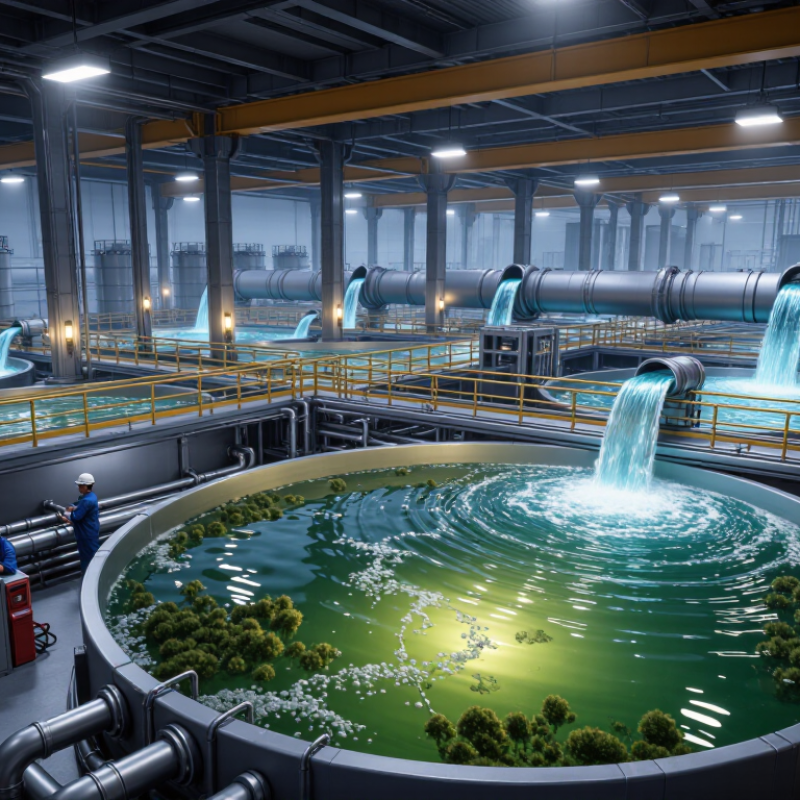
Biological water treatment relies on living communities of bacteria and other microbes to consume biodegradable pollutants. In an aeration basin, fine bubbles supply oxygen while microbes gather into soft flocs. They use dissolved organic matter as food, converting much of it into carbon dioxide, water, and new cell material. The U.S. Environmental Protection Agency’s Wastewater Technology Fact Sheet: Activated Sludge reports typical biochemical oxygen demand removal of 85–95%. That is a useful benchmark, not a guarantee. Not magic.
Performance depends on oxygen, temperature, retention time, and the wastewater’s composition. A sudden slug of acidic or toxic wastewater can stress the microbial community; operators may see weaker settling or higher effluent readings. Some complex organic compounds also resist biological breakdown, so pretreatment or another polishing step may be needed. In practice, operators watch dissolved oxygen, sludge condition, and incoming loads—not just the treatment diagram. The 85–95% range can hide uneven results across shifts and seasons. That gap deserves attention when sizing a plant or judging its performance.
Why Choose Biological Water Treatment for Industry?
| Treatment approach | What the microbes do | Typical targets | Main products or outcome | Operational considerations |
|---|---|---|---|---|
| Activated sludge Suspended-growth process | A mixed community of bacteria and other microorganisms consumes biodegradable material in aerated tanks. | Biodegradable organic matter, commonly measured as BOD₅ and COD | Biomass, carbon dioxide, water, and treated effluent; excess biomass is removed as sludge. | Requires aeration and management of dissolved oxygen, sludge age, and solids separation. |
| Biofilm treatment Attached-growth process | Microorganisms grow on a surface or carrier and use dissolved pollutants as they pass through the system. | Biodegradable organics; some configurations also support nitrification | Pollutant removal through microbial growth and conversion, with detached solids requiring separation. | Media and flow must be selected to limit clogging and maintain effective contact between wastewater and biofilm. |
| Anaerobic treatment Oxygen-free biological process | Communities of anaerobic microorganisms convert biodegradable organic matter through several stages, including methane formation. | Concentrated biodegradable organic wastewater and organic sludge | Biogas, mainly methane and carbon dioxide, plus stabilized residual biomass. | Does not require aeration, but needs suitable conditions such as temperature, pH, and protection from inhibitory compounds. |
| Nitrification Biological nitrogen conversion | Nitrifying microorganisms oxidize ammonia first to nitrite and then to nitrate under aerobic conditions. | Ammonia and ammonium nitrogen | Nitrate; nitrification changes nitrogen form but does not, by itself, remove total nitrogen. | Needs oxygen, sufficient alkalinity, and adequate microbial retention time; performance is sensitive to temperature and inhibitors. |
| Denitrification Anoxic biological nitrogen removal | Denitrifying bacteria use nitrate as an electron acceptor when dissolved oxygen is limited, typically using a biodegradable carbon source. | Nitrate and nitrite | Nitrogen gas, which leaves the water; this reduces total nitrogen when combined with nitrification. | Requires an anoxic zone and an available carbon source; excess oxygen can limit the process. |
| Enhanced biological phosphorus removal | Phosphorus-accumulating organisms take up and store phosphorus in biomass under alternating anaerobic and aerobic conditions. | Orthophosphate and other biologically available phosphorus | Phosphorus is removed from the water when phosphorus-rich biomass is wasted as sludge. | Needs suitable cycling conditions and readily biodegradable carbon; chemical polishing may be used where lower effluent phosphorus is required. |
| Industrial application fit | Treatment design selects and maintains microbial communities suited to the wastewater and required discharge or reuse goals. | Food-processing, pulp and paper, and other wastewater streams containing biodegradable pollutants, subject to treatability testing | Can reduce biodegradable organic load and, with appropriate process stages, nitrogen or phosphorus. | Toxic compounds, salinity, pH shifts, temperature changes, and variable flows can inhibit microbes; pretreatment and process monitoring may be necessary. |